Monday, April 6, 2009

Blog fail

Yeah, so you can sure tell things got busy over the semester as this is my first post in about a month and a half. Blog fail.

Three interesting tidbits to highlight: 1) Someone in Australia has found Schindler's list in a donation from the author of a book that detailed Oskar Schindler's efforts well before the famous movie. This is just amazing as it's a real piece of history someone found, which saved over 800 people from death in 1945. Check out more information at this link here

2) I think this is the same dude who was a complete jerk to me when I commented on the CASLIS blog over the summer who writes this commentary about the lack of leadership at Library and Archives Canada. It deates from January, but does have some interesting thoughts packed inside a questionably written metaphor. Satire is never for the faint of heart. My intial reaction was "well who cares if Canada isn't on the cutting edge of librarianship? No one cares about us anyways unless they wish to emigrate here". He seems to have a lot of issues with LAC looking into electronic files and how ones deals with them; I fail to see what is wrong with this as this is the future of records, and no one has come up with any system for dealing with electronically born files. To see what his hullabaloo is all about, click this link . I personally think Gillian handled it brilliantly!

3) Oldie but this bring up a good discussion on what to do when the catastrophic happens: the State Archives in Cologne, Germany completely collapsed on March 3, 2009. And when I say , completely, I mean flat building with lots of rubble. See this article written soon after the accident from Der Spiegel.

Cologne's historical archive is the largest such municipal collection north of the Alps. It contains some 65,000 documents pertaining to the city's history, including one dating all the way back to the year 922. The archive also contains some half a million photographs. The building which collapsed on Tuesday was built in 1971 to house the archive.
This article written last week states that the metro that is blamed for causign the building to collapse will continue its construction, but it seems there is a huge investigation ongoing into the cause. I did see some pictures of the recovery of some archival documents but I woudl be very curious to see some statistics on what was able to be recovered. If you do not have a disaster plan in place, make it a priority!!

I wish all my fellow students luck in this last week of classes; it's been a busy semester but it is almost over. See you out this week at the end of the year party, or at the ACA pub night!!

Wednesday, February 25, 2009

It's the most wonderful time of the year

As you and your colleagues duke it out for jobs!! Kidding aside, I am VERY curious to see how this will work itself out for everyone. We have the Job fair this Friday for the U of T students, but with all this talk of recessions and such, I'm curious to knwo if the 30+ organizations are indeed hiring, or are there just to be seen.... I'll be there in suit and heels!


One interesting nugget I found on the archives blogs was this posting about a completely online program from the University of Arizona. It's called the Digital Information Management certificate (or DigIn) and because it's all online, can be done from the comfort of your domicile. Sounds VERY intriguing, but I wonder what they charge for out of country students?? If you're really into web technologies or are usure of how to sell yourself in the profession, this might be a good goal to have in mind.


We had a successful trip to LAC last week. Myself and six other students were in Ottawa to visit the Nation's Capital and see the Preservation Centre out in Gatineau. Although there were few people out on the roads (contrary to my summer experience), we had a superb tour and got to speak with archivists. I appreciated their candour about trying to find a job with the feds as they love what they do but hate the bureaucracy. As someone who just completely messed up a job opportunity, it was nice to know I can still work there. It was also good to know that the Portrait Gallery is not dead; it's just in limbo. We also got to see the Staff Resource Centre and 395 Wellington. It was a BUSY day but worth the trip. I just hope someone will do the same for the new students next year.


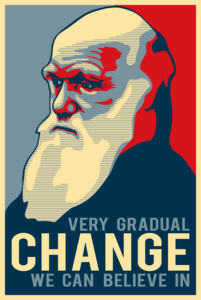
I leave you with a spoof on the famous Obama poster, now embroiled in a silly copyright dispute:
Happy 200 years Darwin!!!

Thursday, February 12, 2009

Darwin's Birthday


Well I can't pass up a moment to mention one of the greatest minds in science. Today would have marked his 200th birthday (a concept that always makes me chuckle, as no one lives 200 yrs! A Victorian would have a conniption in times like these). Check out this special section at New Scientist for more reading pleasure.

This week saw two postings about digital preservation. Turns out they were about this story from the New York Times which highlight the position of digital preservation officer (or some combination of the words 'digital' 'archives' 'preservation' etc). One of the people profiled feels that barring some gargantuan economic slowdown, there should be huge increases in the numbers of people working in the field. Sounds promising, barring economic slowdowns....

On a similar vein, the BBC is going to try and digitize all publicly held paintings and make them available online for all to see. This would be a real coup for art historians, but more importantly for people who cannot get to England and see them in person. This is truly a herculean uptaking, but this collaboration with the Public Catalogue Foundation would create a fantastic resource.

Just a quick post this week, as I am off to see LAC next week with students from U of T. We should learn a lot.

Monday, January 26, 2009

miscellanies and sundries

Boy oh boy, there I was last week lamenting the lack of stories and a whole bunch came out this week.

First up: Not really an archives story but they discovered weapons-grade plutonium in a US dump
from Project Manhattan. This is one of the earliest batches of plutonium-239 ever created. This headline made me wonder "if they had a good records management program, would this have happened?" That 'this' being leaving the plutonium behind in a safe. BUT they did use records to discover what the substance was contained in the glass. According to the article,
"His team read that a safe matching the description of the one unearthed in 2004 was sealed in 1945 because of radioactive contamination. It was disposed of in 1951, and remained lost for the next 50 years."
What entailed this disposal?

Next cool story I found was a Canadian one where the National Film Board made its vaults available online. It seems this is an ongoing project, but there are tonnes of live action, cartoon and other types of films. Check it out here.

You can also watch other awesome clips that I'm sure you remember like the Big Snit, the Log Driver's Waltz and the Cat Came Back. I salute you NFB, other Canadian institutions seem to be so cautious about using the Internet and you just make it all accessible. Fantastic!!

From the NY Times, it seems that Wikipedia may introduce stricter rules for changing the entries. I think this is probably necessary but it's a tad irksome as Wikipedia is one of the most interesting and large scle forms of web 2.0 technology, and all it took was a few attention seekers who wanted to post erroneous information to cause a change. Typical, the troublemakers always wreck it for the rest of us.....but to ensure its legitimacy as an information source, this might be a timely move for Wikipedia.

A subject close to my heart, Monty Python now has an official youtube channel. Now you too can watch your favourite shorts. I'm still waiting for Confuse a Cat, Dinsdale and the Bishop!

The newest large archive to enter into mass digitization for the people is the German Federal Archives, or Bundesarchiv who have hooked up with the Wikipedia Commons. they will be uploading between a few hundred to a few thousand omages a month. The Bundesarchiv is going at this with more enthusiasm than the Library of Commons, as they are only uploading about 50 images a week. The gallery also comes with the following warning:
Please keep in mind that many photographs were produced for propaganda, especially pictures from Germany during the National Socialist ("Third Reich") period and from the German Democratic Republic ("East Germany"). The Federal Archive usually retains the original or historical descriptions. These descriptions can be wrong, dated, politically extreme or offensive.
This is valid and should make people aware that they are portrying history as best they can, warts and all. Especially when dealing wth the history of Germany, there will be some awkward moments, to use a profound understatement. This seems like a very cool project and having all these accessible photographs now makes me wonder what school projects will be like in time.

I rather wish LAC or some other venerable Canadian institution would get in on this as well!


Wednesday, January 14, 2009

Happy new year

And all that stuff. I have been trying to fond something interesting to discuss since coming back, and the archives blogs have really only started being interesting this week. But I won't be using them as I don't really care too much who the new US Archivist will be (it is important, but less so in Canuckistan). However, good times were found by Rebecka and myself so here we go:


Firstly: awesome article from the CBC about public domain and Wallace McLean. I'm not 100% sure what this guy does as although I have seen him on the ARCANL listserv, I don't think he is an archivist by trade. What he does do is keep a blog that tracks works that enter the public domain which isn't easy to track due to the differing times in each country. Grey Owl's writings have been in the public domain in Canada for some time, but are now jut available in Europe.

One thing I didn't know is that although in Canada published works enter the public domain 50 years after the death of the individual, there is this waiting period of another 50 years for unpublished items, that is archival material. This has never been mentioned in class, so I'm going to do some digging to see what this is all about.

In addition to this, turns out Gandhi's writings are now in the public domain in India.

The other story that I have been finding endlessly interesting is the firewall they are attempting around Australia. I may be wrong but it seems the main point of crafting such a security effort is to protect the children from porn and other nasty bits of the internet. There is already the great Firewall of China where they protect their citizens from silly things like protests and democracy. I'm not sure I follow the logic in having a country pretending to be a parent to its citizens. I think it would be far more effective to encourage information literacy and good choices than just making it all illicit, as that adds in more of a cachet. I also know the interwebz isn't so great to begin with in Australia, so adding in another level of throttling will not help.

Don't forget, if you want to participate in the ACA conference in Calgary, submit an abstract for a paper to be considered!!

Wednesday, December 31, 2008

On this last day of 2008

I can say it's been an interesting year! I have a few things to post about that I have been meaning to mention, but they fell by the wayside with the end of term and family illness.

First on the roster; the use of flickr commons by libraries and archives. I do believe the Library of Congress released images here a while back and now the New York Public Library has done so as well. From this boingboing mention, it seem really cool that large institutions are releasing their images to the world. Taken from a blog from the NY library:

About a year ago Flickr launched the Flickr Commons, a project dedicated to sharing and describing the public photo collections of the world's leading cultural heritage institutions. Starting this past January with The Library of Congress, and continuing with places such as The Smithsonian Institution, The Brooklyn Museum, The National Maritime Museum, The National Library of New Zealand, the Nationaal Archief of the Netherlands and numerous others, the Commons has grown steadily over the past year into a truly remarkable public photography resource
I mean what isn't awesome about cyanotypes of algae? I think this is a brilliant use of the interwebz and all this web 2.0 jazz we hear about over and over. This is designed to encourage use and description of the images, but this also provides another method of marketing (yes I did say that!) for these institutions in showing off some of the rich collections they hold.

A quick search of flickr did not show any loads from the LAC, which is too bad, so I hope it is on the horizon. I did come across an image of one workstation I used in the Staff Resource Centre in someone's photostream....

Next up; I really goofed on this one as I saw it posted on boing boing and it didn't even register that this was an ARCHIVE. D'oh. The LIFE magazine photo archive is now posted up on Google image search (click here to scope it out). I am quite sorry I came late to this magazine as I adore the photographs, and when the magazine folded, I was very upset. Now, all can access these images. As indicated in the spellbound blog, to search only the LIFE images, you type in source:LIFE as one of the search terms. The images are fascinating as it seems like you get far more shots than what would have appeared in the finished story. I looked up fashion and then clicked dresses from one linked story about Hermes trompe l'oeil dresses from 1952, and there are easily half a dozen more variations on each shot. Just fascinating.
My only quibble from this is I would love to have the stories there as well to know the context for the images as they would have been in the magazine. But this is another whole project full of copyrights and other nonsense that I'll stay away from. Do note that this project is different from the aforementioned flickr commons one where tagging and interaction is encouraged. Google has already come up with all the links, tags, and organization for this giant set of images. I did note in looking at these dresses, there was only about say ten similar images indicated by Google, but there were far more related images in my search...

I thought I had more to share but the pickings have been slim and I haven't been anxiously hunting down the stories as a good blogger should. So enjoy this last five minutes of 2008!

Boing boing Gadgets just informed me that 2009 is the International Year of Natural Fibres so have a good one!

Thursday, December 11, 2008

Bored? Need a video?

Here are two videos I stumbled across this morning:

http://www.youtube.com/watch?v=xu6sRNpnDSU


http://www.youtube.com/watch?v=06gZ3QSpds4


Now you know all about archives!

Friday, November 28, 2008

For all of you who think the interwebz isn't popular...

We haz the Europeana site!! Ok, no more lolspeak today, but this is a really cool initiative where the European Commission has invested just scads of euros to create a Europe wide digital library available online 24/7. Cool right?

Well, it is until you get 10 million hits per hour when you launch causing the site to crash.....

So the site is recalibrating and should be relaunched in mid December. You can click here for the future site

I find this just fascinating for two reasons; firstly, wow, ten MILLION hits an hour? That's a popular website. I wonder if we can learn from something like this and have more efforts being put forth into digitization on a large scale. They will be featuring items from the Louvre and the British Museum to name but two museums. According to one article,"the images online include the Magna Carta from Britain, the Vermeer painting “Girl With a Pearl Earring” from the Mauritshuis Museum in The Hague and a copy of Dante’s “Divine Comedy.”" (NYT Nov 20, 2008).

The second reason this fascinates me is due to the fact that France apparently dominates submissions to the Digital Library. I lived there four years ago and found the internet to be a little lame on French websites. I have to take that view back since I used Les Archives du Rennes last year for a project and it was a fabulous website. The website for La Ville du Rennes is also quite good. And France had submitted over half of the two million articles that were up on Europeana, even writing other countries' histories for them (NYT Nov 20, 2008). I'm not sure if this is part of trying to protect the French Culture, or if France has placed a great emphasis on being part of digital initiatives, but they have so much culture to draw upon.....I can see why they submitted so much!

I look forward to going on the new version of the Europeana website to see what it's like. And I'd also be curious to see what sorts of bells and whistles they are using, as maybe those could be used here in Canada. Well, that is if we ever got digitization funding again.....

Tuesday, November 18, 2008

so I was busy doing another project for an archives course

and trying to find images of Jenkinson and Schellenberg as I became curious to know what these famous names looked like. Google pointed me to this little gem: Archivopedia! Looks like we have our own little wikipedia to call out own. It seems to be in the beta testing phase, and although I only tried searching two things, this could be a fun little encyclopedia to which we all could refer.

My wish: drop the 1986 colour scheme of teal and dusty rose (?) or lavender with rounded edges... Not modern looking at all.

Would a logo help?

Another good posting by the Records Junkie, this time suggesting archives need a logo akin to what is used for hospitals or libraries. He states:
A logo will let our researchers and our donors know who and what we are. There will be people who don't know what an archivist is who will recognize the archives logo (symbol?) as a place that safeguards and preserves historical materials. They will know who we are, what we do, what we stand for.
Although this is a good idea, I always chuckle when I hear words like "they will know what we do". Right, like the name change we just underwent to become the Faculty of Information. Our old dean tried to tell us it would become like medicine or law, so when asked what we study, all would understand information....(another debate for another time....). But the Records Junkie has a point, had I not become a student in this program, I would never have known what an archives does or where they were. A little logo like the L man reading a book could help the public understand archives or at least know that we're some sort of cultural institution.

I wonder what would work, an "A" made of documents? A magnifying glass? White gloves? A filing cabinet? Something to ponder.

Those November blahs....

Which means I haven't been posting like I should be. I could say I have been busy with school and I wouldn't be lying, but I'm not doing so well in the blogging department. I have been saving some items of interest which I wanted to bring up:

Firstly: Just in the interest of copyright, Charlie Nesson, a US lawyer has taken up the case of a Boston graduate student who has been charged by the RIAA for file sharing. Why this is big news is Nessen is the guy who they based "A Civil Action" on, so we're talking about a whip smart lawyer who will defend the little guy against the ridiculousness of corporate interests. According to Cory Doctorow:
"Nesson argues that the Digital Theft Deterrence and Copyright Damages Improvement Act of 1999 is unconstitutional because it effectively lets a private group — the Recording Industry Association of America, or RIAA — carry out civil enforcement of a criminal law. He also says the music industry group abused the legal process by brandishing the prospects of lengthy and costly lawsuits in an effort to intimidate people into settling cases out of court."
See larger post plus link to full story here

Second: The Records Junkie has been posting some really well thought out ideas. The first one was his wish list for archival accreditation. Although his list is quite extensive, he brings up some good issues. I gather from wish #1 that not all programs in archives/public history/information science/library science are accredited. I mean, our program here at U of T is accredited by ALA, but we have no Canadian equivalent. I also know some programs, notably the one at UC Berkeley dropped the ALA accreditation. And there were rumblings that they were to drop the ALA one here....I'm quite glad they didn't as we're not Berkeley!!

He also points out many areas where there should be archivist courses. I'll just copy his list:
a) selection, appraisal, and acquisition;
b) arrangement and description;
c) reference services and access;
d) preservation and protection;
e) outreach, advocacy, and promotion;
f) managing archival programs;
g) professional, ethical, and legal responsibilities
We have courses in most of these topics, although sometimes I feel that these subjects get glossed over. I know I'd love more courses on the last three topics (e, f, g), especially professional, ethical and legal responsabilities. Although I can see this being part of the large category of "things you learn on the job", there are relevant subjects that I know little about like copyright, but I'll be dealing with every day.

I fully agree with his wish for hands on experience. I selected to take a practicum course this term, and I have learned so much from this, both in being able to apply what I learned in class, and more of the ins and outs of working in a small archives. This desire fpr hands on learning is a continual chant (rant?) we have from time to time in the program...

Some of his suggestions that would be brilliant if they were even a remore possibility are things like having the SAA put their stamp of approval on the graduate program, having classes at a ratio of 15 students to one faculty member, and having interships available to pay for school. I wonder if the ACA would imagine doing this in Canada (Likely not, we only have about....3 programs if you include the University of Manitoba). But having interships would help our funding. We pay a lot to get U of T on our diplomas! Smaller classes would be great too. They wish to increase the numbers in our Information Studies program, so this means we have classes around 20-30 people at the smallest...not optimal at a Master's level.

We have an active ACA chpater this year, so at least the student body knows we are out there! I hope this continues next year as well. All in all, I think the Records Junkie has some good suggestions in his wish list that should provoke thought and discussion to see where archives programs will go in the future. This will be interesting to see what happens when the SAA comes out with its education report.


Monday, November 3, 2008

Homegrown case study in why archives and records management are important

You may or may not be keeping up with the story of how over 400 women received inaccurate breast cancer tests in Newfoundland and Labrador which As stated in a CBC article, these patients received inaccurate results with hormone receptor tests which were to help determine whether a patient can benefit from the anti-hormonal drug Tamoxifen between 1997 and 2005. For whatever reason, these issues with testing were withheld from the public and the patients.

[The many days of testimony] "conclude an examination that has revealed serious issues within the health-care system, including the often-neglected field of pathology, ethical issues of patient notification and how well staff are trained for their jobs".

A focus of the inquiry has also been how agile the health-care system is in responding to reports of problems.

Smith said the experience of the inquiry has already led to substantial changes in quality assurance, but said there are still risks if staff do not step up and file reports.

"I think we've made major efforts to try to educate people about what an occurrence report is, why it's used, how it can improve patient care and safety, but some people just don't use those report forms," Smith said." (CBC News October 31, 2008).

The other big story along with all the issues of withholding information is the loss of one of the computers used in the diagnostic testing. Apparently after the computers are deemed too old, they are put in a landfill. But the records are not wiped clean from the system. An older news story mentioned that these computers were in a dump in St. John's but it turns out a technician had taken the computer, refurbished it and sold it. He managed to track it down to the University of Virginia, who were more than happy to forward along the requested records. My question, which is the same as many others, is why wasn't the computer wiped before leaving the hospital???

You can be sure the hospital is in some serious trouble as this reveals inept record keeping procedures as well as patient neglect and improper records disposal. This will continue to be an interesting but sad tale, as 108 women lost their lives to breast cancer, and it is uncertain if tamoxifen would have helped them.

(Thanks to the Canadian Archivist blog for highlighting the story)

Wednesday, October 22, 2008

lots of archival goodness this week

I found some more archival blogs, some of which posed some excellent questions about the discipline. Firstly, I wanted to recap with some more information from my last post about the National Archives and Library of Ireland. Turns out unlike here, they are putting the two institutions together to save money. What does that entirely mean?? Job losses? or it is merely fewer buildings? I am guessing this has been done by politicians who have little to no concept about what it is these two institutions are about. Something to keep an eye on...

I found this excellent blog called ArchivesNext where Katie asks some truly thought provoking questions about archives. I thought I'd have missed all her insights as she claimed to be heading off on a vacation from blogging, but then came back with a brilliant posting about archives as a luxury. Read it here. And she is entirely right. It come up over and over in my classes that we are fighting for the same funds as the police or fire brigades or community centres. In light of the definite economic slowdown (read recession), how do you convince people that you are just as important as safety?

I thought this was an important point:
"Are libraries a luxury? Maybe, but far less of one than archives. Public libraries make a good case for why they are an essential part of their communities. Can archives do the same? Why should the ever-shrinking pool of available government (or private) funds be granted to your archives so that you can process your backlog or digitize your collection? What’s the public good? What’s the benefit to anyone other than historians?"
These are all important questions that we will have to answer in order to defend what we do. And I am not sure I have any good answers. As Katie points out, we need to know our importance in communities so we can fight smartly for funding. We need to prove that archives might be a luxury in tight times, but we have a purpose and use.

I am a little spooked about trying to find a job after graduation next year, what with the probable recession that will hit, so we will all need to work harder to prove our worth when times are tight.

Wednesday, October 15, 2008

sometimes you gotta chase the story down

I have been anxiously awaiting exciting archival news, and none has appeared (at least via my passive methods of collection. I love bloglines). So I went a-huntin' tonight to see what I could find. I tripped onto this interesting post from the University of London's Computer Centre's Digital Archives blog (or ULCC DA blog). Anyway, one of their staff posted about the move to unite the National Library and National Archives in Ireland (see post here) and how completely awful this could be as the Archives will lose its independence.

I found this to be an interesting position as the National Library and Archives here have been put together to make Library and Archives Canada. Now I haven't any idea if there was even minimal uproar over this a few years ago, but after working there over the summer, I don't think the move was a bad one. And I also don't think I met anyone who disagreed with putting the two together either; they were more upset with the move to the middle of nowhere, Gatineau.

So is putting one's national library and archives together a bad decision? We had one woman from Switzerland and another from Tasmania who both came to see how the amalgamation worked. In smaller countries, this may be a viable option as it puts two similar institutions together and might increase budgets and resources (this might be optimistic...). This would never work in the US or Britain as either institution there is LARGE and I would not want to know how large a building would be needed for a combined library and archivesin either place.

I could understand the poster's dismay if the Archives in Ireland was getting absorbed and the archivists were being laid off, leaving librarians in charge. But I was surprised at the overwhelming negative reaction to this.....I'd love to know why the Irish Government is doing it.

Tuesday, October 7, 2008

Now they have me seeing red....

So I spent a good deal of my summer learning all there was to know about the Canadian DCMA and was thrilled to pieces when the bill was stopped due to the election. Then what do I spot at boingboing??

"The Conservative Party has released its platform and it devotes a half-page to copyright that leaves little doubt that it plans to bring back Bill C-61 and continue to support ACTA. According to the platform:

A re-elected Conservative Government led by Stephen Harper will reintroduce federal copyright legislation that strikes the appropriate balance among the rights of musicians, artists, programmers and other creators and brings Canada's intellectual property protection in line with that of other industrialized countries, but also protects consumers who want to access copyright works for their personal use. We will also introduce tougher laws on counterfeiting and piracy and give our customs and law enforcement services the resources to enforce them. This will protect consumers from phoney and sometimes dangerous products that are passed off as reliable brand-name goods."

(See Cory Doctorow's full post here)

In a sound, not a word: faugh. This bill was done without consultation and harms rather than helps the parties involved. Time to gird ourselves for the copyfight AGAIN.

For background information as well as updates on this (possibly) unfolding mess, check out Michael Geist's blog at www.michaelgeist.ca

Monday, October 6, 2008

Google in the archives

The lethargy got me (although there wasn't a heck of a lot in blogland....although I didn't quite check) so I haven't posted in a spell....

One story that caught my eye today was this little number from The Industry Standard which asks what if Google's mission extended to public records?? An excellent question, and as we know, public perception of what has been digitized and what actually has been transferred are quite different. Ian Lamont here speaks about genealogy and how little there is available to help internet savvy searchers find more about their families. This simple seemign question brings to my mind a whole series of questions like what woudl Google's interests be in this? Would they then own the public records of what they scanned, like censuses (censusi?) or ship records? And would this indeed help the public sector as the documents would be scanned and thus would increased access for this insitutions' users? And again, with digitizing all these records, what becomes of the archivist? A good set of questions that I can see coming back in a few years.

Wednesday, September 24, 2008

So apparently ordinary people are just chum

Another good article about the art and culture cuts that the Tories want to enact:

Toronto Star Article "Ordinary People don't care about arts"

Now whether you agree with government support for the arts or not, recall that a portion of this was for digitization projects which would increase access to many resources. As we all know, many small archives and museums are strapped for cash so any funding for digitization would be very welcome. And most of the arts funding was to send off groups to show off Canadian culture around the world. I fail to see why this is a bad thing. As the article states and many commentors point out, many of these so call "rich" artists barely make much over the poverty line. I think I react the most to the comment of "ordinary Canadians don't care about the arts". It's probably because we don't get a chance to see much art and culture in some areas of the country. Now we may never see it as there's no funding for it.

Also the comments about privatizing the CBC really send a chill up the spine. The ol CEEB isn't doing so hot these days but it would be a real shame to lose it. I would like to direct your attention to a brilliant speech given by Stephen Fry about the BBC in England. I think we could learn a lot from this: Stephen Fry's blog

It will be interesting to see how this plays out in days to come...
-Jess

Tuesday, September 23, 2008

Cheney can't hide his legacy...

An interesting story from LISnews.org:

A federal judge issued a preliminary injunction yesterday ordering Vice President Cheney and the National Archives to preserve all of his official records.

U.S. District Judge Colleen Kollar-Kotelly's order came in response to a lawsuit filed this month by the watchdog group Citizens for Responsibility and Ethics in Washington. The group, joined by several historians and open-government advocates, warned that Cheney might destroy or withhold important documents as the Bush administration winds down if he interprets the Presidential Records Act of 1978 as applying to only some of his official papers. ...

(For more, click here)

Being in Canada, I haven't the foggiest if the PM or anyone else is held by law to keep papers, but as a budding archivist, I would be quite disturbed to see these papers destroyed. History will be the final judge of the Bush Administration and their legacy however the loss of papers will definitely affect the optics. As the journalist states later on, Cheney is considered to be one of the most influential vice presidents ever, and his role in the Bush Administration will continue to be examined for years to come.

This also shows how important laws can be in forcing accountability. Who knows if these historians and other groups will truly be successful in ensuring all the Cheney papers remain, but at least someone is looking out for history.

Tuesday, September 16, 2008

The Marilyn Monroe files

Just in case you are curious:

http://www.vanityfair.com/culture/marilyn/marilyn

(courtesy of the ArcanL Listserv)

Sunday, September 14, 2008

From the Arcan-L listserv:

"Make the case for culture to ordinary Canadians..." at http://www.cbc.ca/arts/story/2008/09/11/arts-panel.html
In the realm of the digital: at http://www.cbc.ca/spark/, episode 44 includes an interview with Brewster Kahle on "why, for the sake of our culture, we need to digitize works of print, audio and video;" and Ed Burtynsky discusses "photographs that will last 10,000 years."

(courtesy of Cheryl Avery, Univeristy of Saskatchewan)

In light of recent announcements of cuts to cultural programs, the CBC article raises an excellent point about arts funding. How does one justify the needs of artists during an election when there are perhaps more pressing needs? Does someone who lost their manufacturing job really care about having touring artists travel the world to show off Canadian culture? Although, I haven't looked, I doubt any of the party leaders have announced any arts or culture funding.

I haven't yet listened to the Spark one, but I find everything to do with the Long Now project just fascinating. I"d be interested to know how they think format shifting will be overcome. People think in such short lengths of time that it is refreshing to see projects that will take perhaps fifty lifetimes to complete. Maybe the Long Now people should talk to our politicians....

-Jess